

How It Works
1. Component Preparation
Standard semiconductor packages, bare die, chiplets, and passives are placed face-down in a temporary alignment structure. Unlike traditional SMT assembly, there is no reflow process and no solder paste.
2. Encapsulation & Structural Formation
Components are mechanically stabilized within a dielectric matrix that becomes the structural backbone of the system. This structure provides mechanical integrity without thermal cycling damage.
3. Direct Metallurgical Bonding
Advanced metallization techniques form direct copper-to-copper or compatible metallurgical bonds between component terminations and interconnect layers. These bonds outperform solder in:
- Thermal conductivity
- Mechanical strength
- Electrical performance
- Long-term reliability
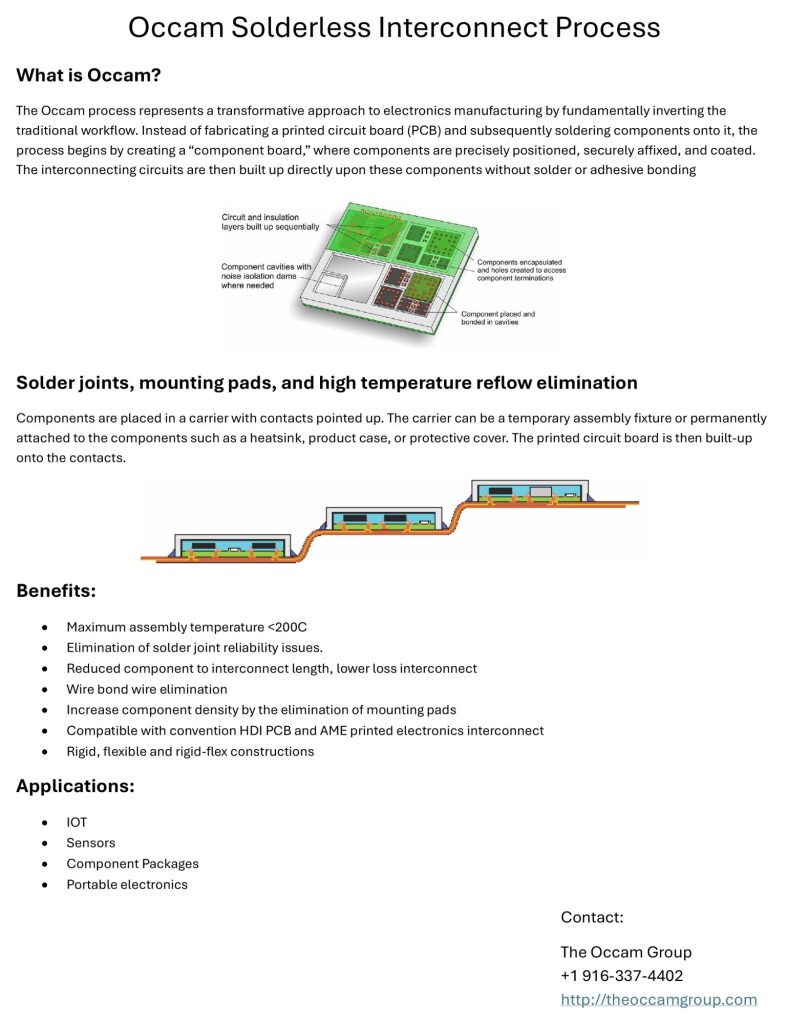
4. Additive Interconnect Build-Up
Using advanced additive or semi-additive processes (including MSAP compatibility), high-density routing layers are built directly onto the embedded component structure. This enables:
- Fine-line geometries
- High-density interconnect
- 3D integration
- Chiplet architectures
5. Final Substrate Formation
The result is a fully integrated, compact, structurally reinforced electronic assembly that eliminates traditional PCB constraints and weak interconnects.